Beans, Again

It’s a four-pots-of-beans kind of day . . .

If you read about food, you probably know about the Rancho Gordo Bean Club: four times a year, members receive a box of six pounds of beans, plus a sheet of recipes (one for each type of bean), plus something extra, plus a code for free shipping for one order from Rancho Gordo. The November box always has a calendar, popping corn, and black-eyed peas, but otherwise the “extra” thing could be a container of some kind of spice, or some grain, or a bean that they don’t have in large enough quantities to sell on the website. They don’t say ahead of time what beans will be in the box, so it’s actually a surprise package (and there are few enough good surprises left in the world). All in all, for someone like me who eats beans at least four days a week most weeks, it’s truly wonderful. 

I have two pots that are suitable for making beans, a stockpot-type pot (which is actually too small to use for a major production of stock) and a 6-quart sauté pan; when I’m going to make beans, I get both of those going, make two pots of beans, and, when they’re done, make two MORE pots of beans, without even bothering to wash the pots between batches. I end up with 46-48 meals’ worth of beans. I also have a million small plastic containers that originally housed fresh mozzarella from the farmers’ market, so I can portion the beans, Sharpie the type of bean on the lid, and freeze them, not to mention track them on the whiteboard.

So how do I eat so many beans? The dinner version is beans, greens (spinach, chard, or kale, depending on the CSA season), some other vegetable (roasted tomatoes; roasted squash; roasted sweet potatoes; carrots; beets), and a grain (barley, bulgar, farro, wild rice), with cheese on top. When I’m feeling especially adventurous, I’ll toss in a spice mix from Penzey’s. I also throw them into any stew-like dish I’m making, such as last week’s turkey pot pie—I had two containers of pintos that had been in the freezer forever. If I make fish tacos, I’ll heat up and then sorta mash some beans. 

I’ve been a member of the bean club for at least five years, I think—maybe more—and it continues to be one of my favorite things. I’ve learned about more varieties of beans than I even knew existed, and I get to support a purveyor who searches out heirloom (rather than commodity) types of beans. Apparently, when Steve Sando first started looking for farmers to grow his beans, they thought he wanted the commodity beans; he said, no, I want the beans your grandmother grows. Today’s beans are Borlotti Lamon, buckeye, garbanzo, and royal corona (essentially, huge white limas); I’ll probably make some pasta e fagioli with some of the Borlottis and a curry of some kind with some of the the garbanzos, but most of both batches will be dinner. 

I also started saving a bean from each batch and planting it, with no expectations—shockingly, they grew, even on my windowsill, even in winter, when it’s light for about 15 minutes a day. The biggest challenge indoors was the varieties that are pole beans rather than bush beans—they climbed my blinds and anything else they could find. And I’ve harvested beans, as well, which is even more entertaining. (When I have enough, I’m going to make a batch that consists of only the beans I’ve grown.) Now that winter is here I have to figure out where to plant the little pile of beans I’ve saved, preferably in a place where they can climb something other than my blinds. They didn’t do well on the back porch this summer (not enough light, perhaps).
Build Me Up, Buttercup

My downstairs neighbor likes to host Thanksgiving (in the form of Friendsgiving) every year; she provides the turkey, gravy, and cranberry sauce, and a collection of others bring veggies and sides. I typically bring a vegetable (this year I roasted our combined stash of Brussels sprouts), at least one dessert (this year was creme brûlée with caramelized apples at the bottom of the dish), sometimes an appetizer (I made cheese puffs but then left them in my freezer; we’ll have some with wine later this week), and bread. This year I thought I would combine some recipes from the sourdough section of King Arthur’s new Big Book of Bread and an episode of The Great British Baking Show, specifically the episode where Paul Hollywood demonstrates a seven-strand braided ring. That is, rather than using Paul’s formula, I thought I’d use a sourdough formula that had approximately the same weight of flour. There was another formula nearby in the book, which I thought would be a way to use the rest of my discard. Both formulae called for unfed starter, so I thought at least one would work, and I could use the rest of any dough for rolls or a formed loaf or whatever.

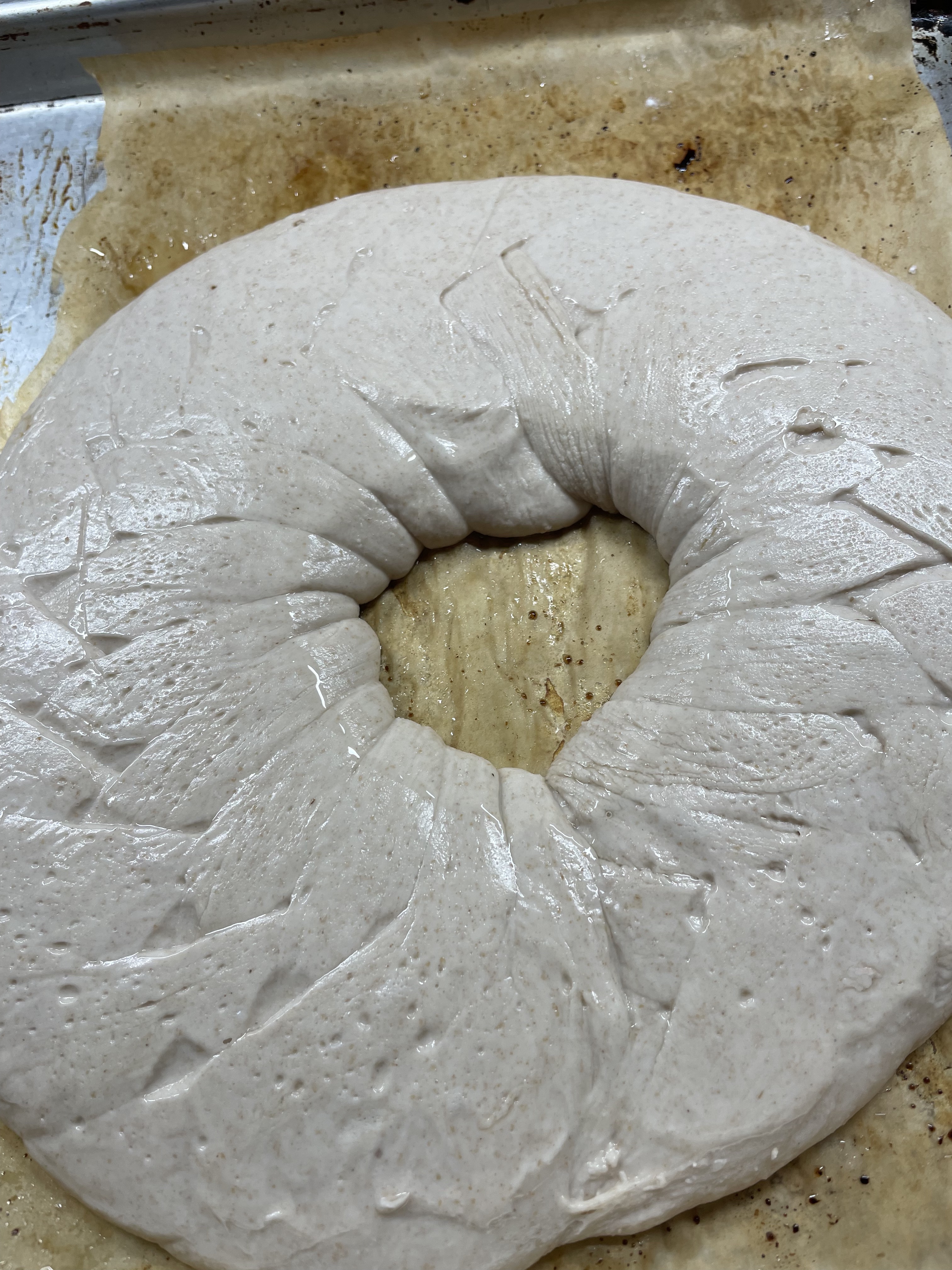
This link shows what the finished loaf is supposed to look like. This, however, is what my dough actually looked like:

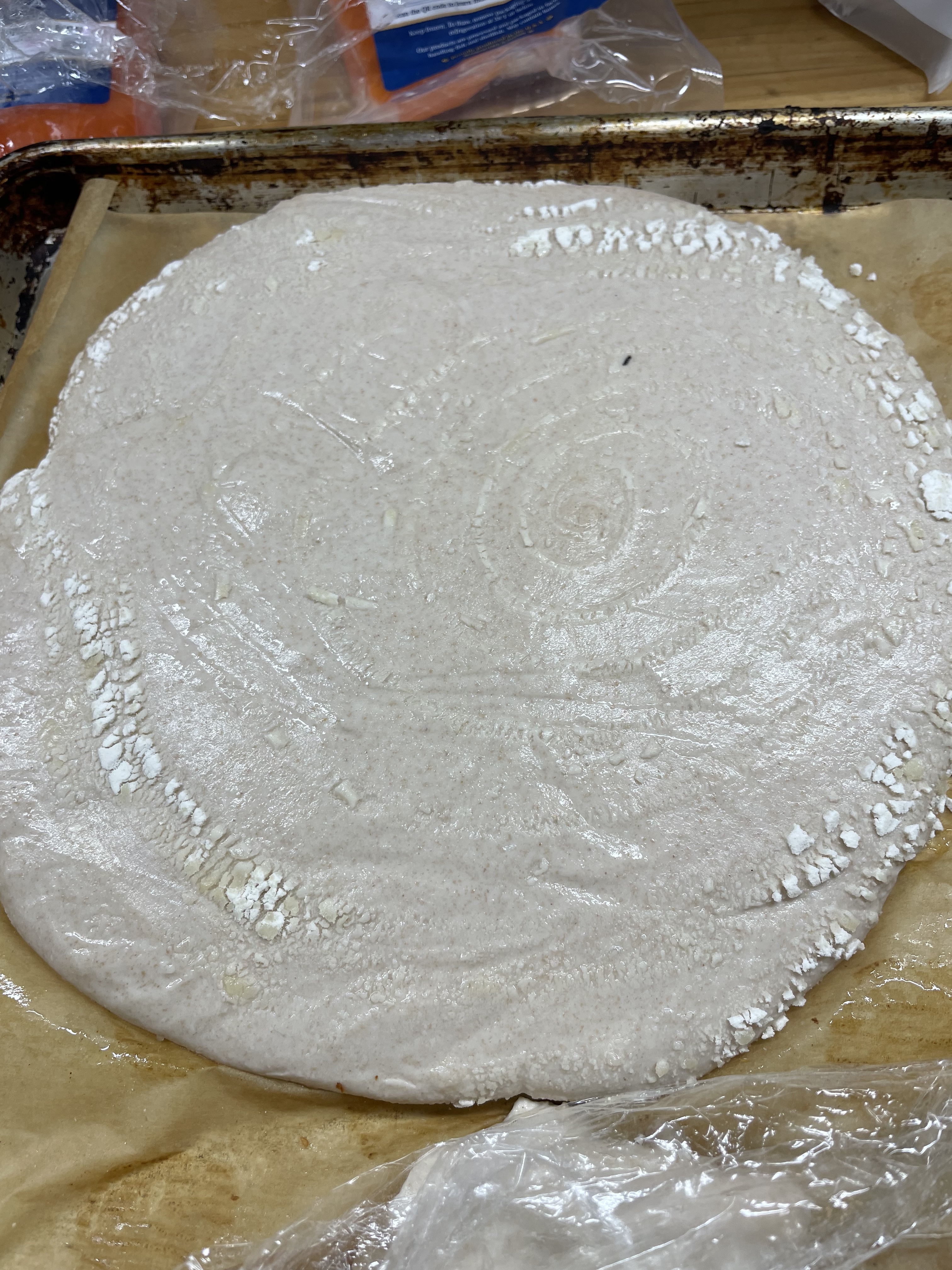
And the other formula? The “safety” formula? No better:

I tried to bake some of the sourdough dough as rolls, but they came out like dense little slightly raised pancakes. The flavor actually isn’t terrible, but the texture is quite bad. They’ll still get consumed, but, oof, definitely a failure. 

Because of all of this fail, on Thanksgiving day, I whipped up another batch of rolls from another King Arthur baking book; the recipe used yeast instead of my starter, and they came out just fine. Quite nice, in fact, with a lovely sweetish taste from the whole wheat. I only made two substitutions. First, I didn’t have any rye flour, so I just used more whole wheat. Second, I didn’t have either orange juice or an orange, but I did have some orange sugar (orange rind mixed with sugar, which I had in the freezer as the leftovers from some other experiment), so I subbed in some orange sugar for both the juice and some of the honey the recipe listed. It provided a subtle tang and sweetness that complemented the whole wheat flour nicely.

I put the two sheet pans of failure dough in the fridge, covered with greased plastic wrap, and figured I’d come back to it on Friday, though I had no idea what I was going to do with the massive quantities. I really did not want to throw it out; way too much flour was involved, and it seemed like such a waste. Finally it came to me: crackersI’ve seen recipes that basically just use sourdough discard for crackers (though I haven’t tried that), and I’ve made my own crackers using Peter Reinhardt’s formula from his whole-grain baking book. I also had a bunch of King Arthur’s Harvest Grains Blend, because it’s a good shorthand add-in when I want to add something to a basic loaf or to waffles or pancakes.

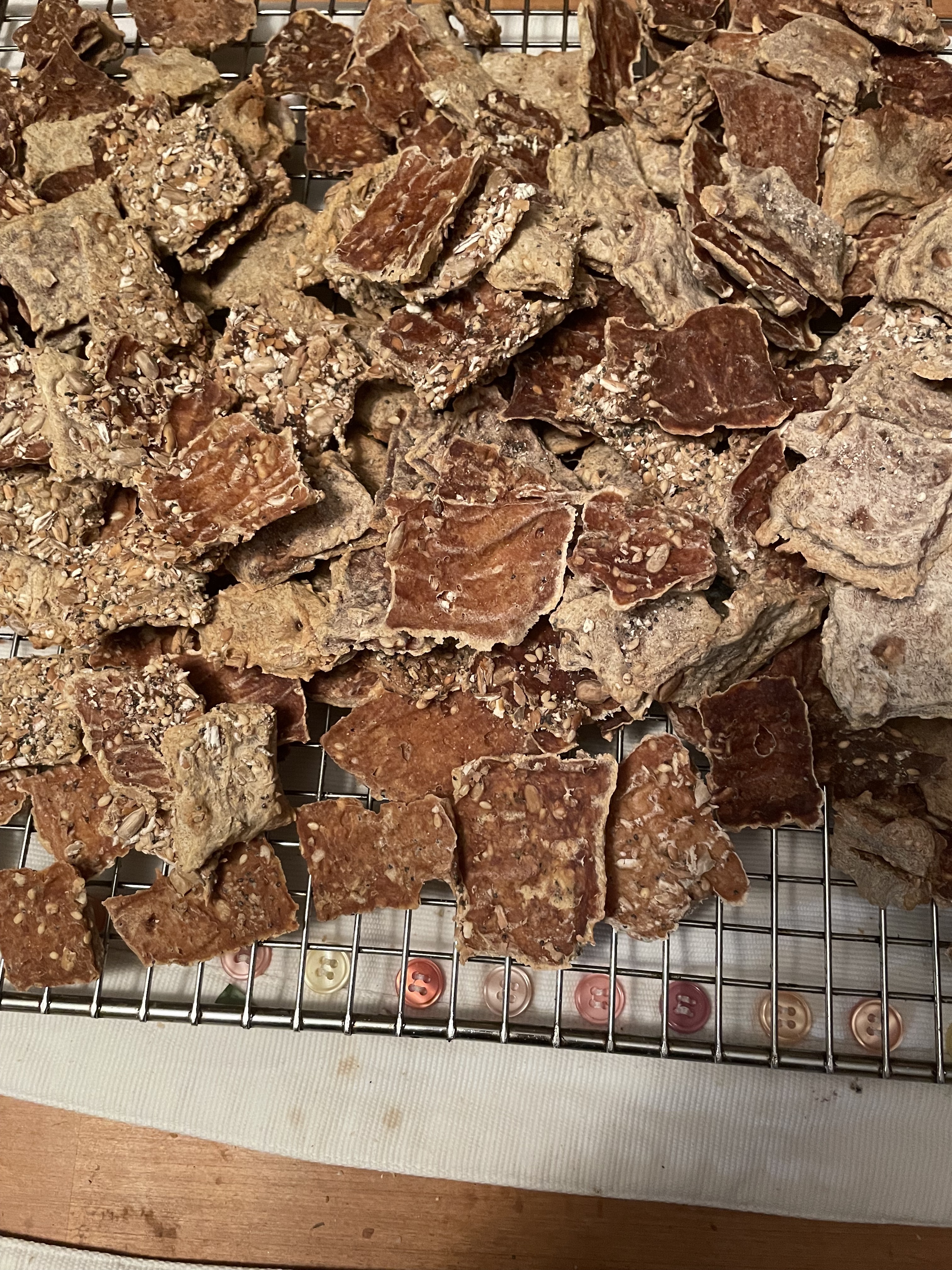
I tried multiple methods along the way—kneading some of the grains into the dough, then rolling it out as thin as possible; rolling it out and then rolling the grains into the dough that way; and, finally, doing the latter and adding some olive oil on top. The first pan didn’t bake very well; one side got brown but the other did not. I kept going, though, and made sure I baked everything through. As you can see here, even crackers that are baked through aren’t necessarily brown on both sides. But! They’re tasty, and crunchy, and I didn’t have to throw out all of that Faildough.

My biggest takeaway—which, frankly, I already knew but somehow keep thinking is going to change by magic—is that my starter isn’t very strong and needs to be built up to use it. It works just fine for my two most common uses, waffles and pizza dough, but if I want to bake bread with it, I really need to build it up before I use it.

Corn

When I was a kid, we sometimes had Sunday dinner with my maternal grandparents. My immigrant grandmother was a great cook; I grew up eating northern-Italian cooking because that’s what she made. She had a sixth-grade education, but she also subscribed to Gourmet and Bon Appetit—it took me years to see that those two things don’t necessarily go together. My mom is also a good cook. I wouldn’t say that either my mother or grandmother taught me how to cook, but they did teach me how to eat and enjoy food by providing it for the table.

One Sunday meal was pot roast and polenta. I eventually figured out that it was cloves in the pot roast, along with tomatoes and red wine, that gave her pot roast its distinctive flavor. And I didn’t give much thought to the polenta; I liked it, a lot, but it didn’t seem special. It was cornmeal and water and some salt, after all; cheap food. Thus, when polenta had its moment a few decades ago, I rolled my eyes. Yeah, you can fancy it up, but it’s still cornmeal and water and salt and stirring.

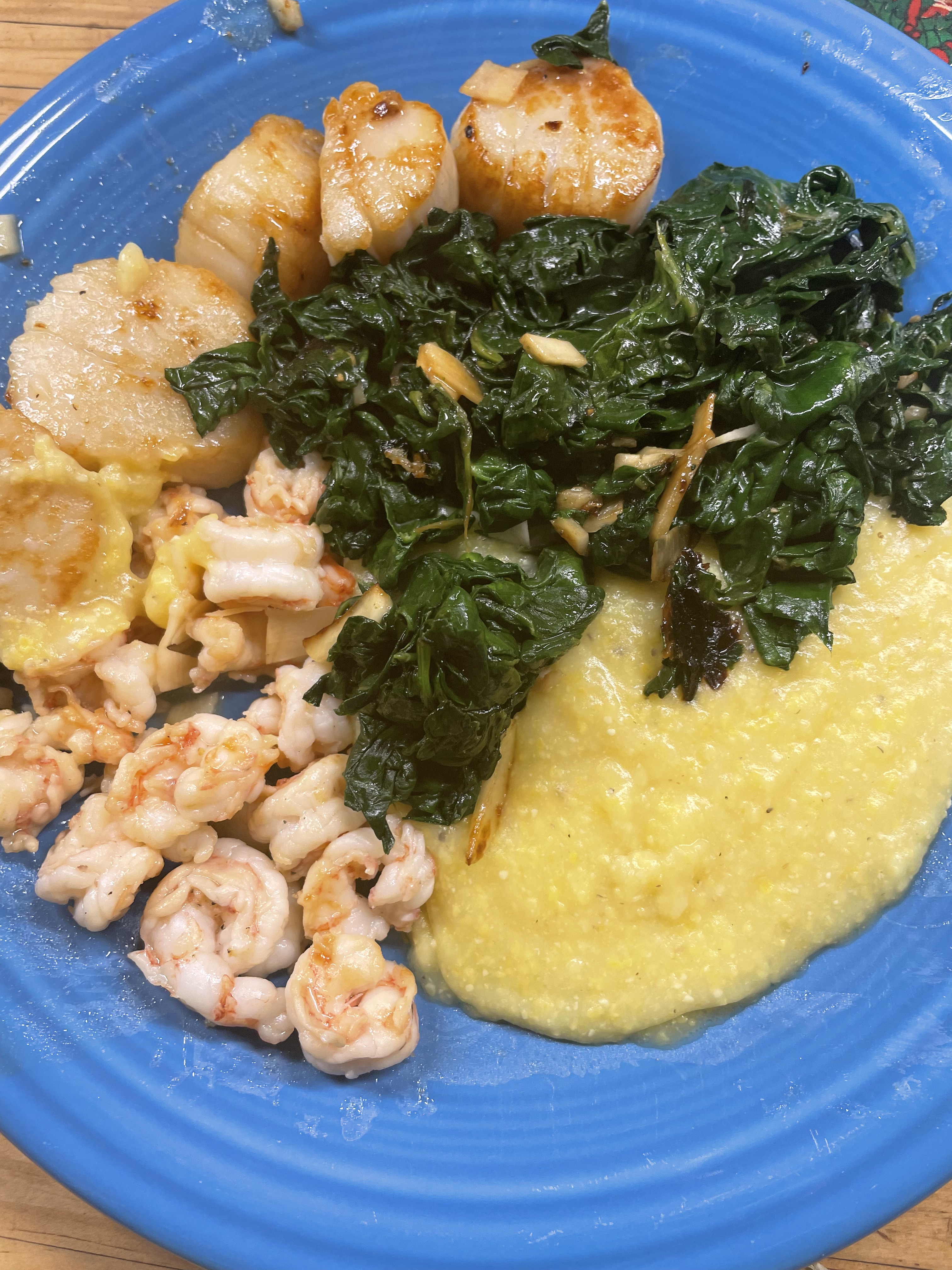
One of my stated principles is to use shit up—find those things tucked away in the freezer and eat them—but it often fights with another deep-seated habit, that of “saving” Good Things rather than using or consuming them. With food, that means I might end up saving something past its prime. (More on this in another post.) So, Sunday I attacked both of those things by making scallops, side-striped shrimp, and polenta; the polenta used up the last of my cornmeal and the scallops have been around awhile. I wilted some spinach and threw it in a pan with a little butter and garlic, too.

The biggest challenge I have with polenta is that I only have two hands. If you use the Marcella Hazan method, you have to drop the cornmeal into boiling water, practically grain by grain, while stirring vigorously; unless you’re truly ambidextrous—I am not—you have to decide whether you’re going to try to stir viscous, boiling substances vigorously, with your non-dominant hand, or try to slowly drop grains of cornmeal with your non-dominant hand. There’s another method—mixing the cornmeal with some of the (cold) water first—but of course I didn’t think to do that when I made polenta yesterday. Ergo, big-ass lumps in my cornmeal. I don’t have an immersion blender, but I do have a mini-prep food processor, so I used a slotted spoon to pull out the lumps, and added some water (from the pot, though I had to use other water as well), and whirred it all up in the mini-prep before putting it all back in. It worked out okay, but the boiling-over-onto-the-stove part, in combination with the adding-water-to-the-lumps part, meant my water-to-cornmeal ratio was off, and the polenta took forever to cook. It was still fine.

I also have a whole LOT of polenta left over. My mom told me that when she was a kid, they’d slice it, brown it in butter, and put maple syrup on it, for breakfast. Instead, what I’ll probably do is slice and brown it, but put my evening beans-and-veggies dinner on top of it. Meanwhile, here’s a pic of last night’s dinner.

Bright blue plate. Yellow polenta at 4:00, spinach at 2:00, shrimp at 7:00, scallops at 10:00.

Real Beer, Virtual Events

The news last week (in my single-person household, anyway) was that my favorite event (the Great Taste) is canceled for this year. It’s a very well-run event, the beer is tasty (and if it’s not, you can dump it because look! There’s more!), and the event has grown to include tap takeovers at many bars and restaurants on the square in the two or three nights priorate the event. The tickets aren’t crazy expensive (if you can get them), but the hotel rooms are. I have gone for 10 of the past 11 years (one year every single one of us in the group I attend with was shut out), and I scored a cheaper hotel room for this year by booking it a year ago, which of course I will not use.

All that said, my first reaction after hearing the news was a kind of relief: even if they had gone forward with it, I was in no way comfortable attending an event that large in August. Even folks who adopt harm reduction strategies (is that beer in your glass? Make sure you have a glass of water before you put more beer in there) are inebriated by the end of the event. Not necessarily falling-down-drunk, but not sober, either. (The organizers also do a great job ensuring there are alternatives to driving, not least by not allowing parking nearby.) The people pouring beer are close to each other as well—the whole event would provide multiple opportunities for infecting hundreds or thousands of people. Cancelling it is the right thing to do. 

Why was I relieved? Because I would have been sad not to be there. I’m glad to have that small disappointment removed. Somehow, the disappointment around the cancellation is less than the disappointment I would have felt if it had happened and I didn’t attend.

I’m still holding tickets to two other events that have not been cancelled, and I’ve requested a refund for a third event that has been postponed indefinitely. Frankly, I’m willing to swallow the (substantial) cost of the non-cancelled events at this point; much as I enjoy the camping and the wandering around the track and everything else, I just don’t see how bringing people from all over the world together, in June or even August, for that matter, is a good idea. I’ve attended these events at these venues; I know what it’s like.

On the other hand, the brewery running series I do is doing virtual races in June and probably July; there was also an April virtual challenge, and I’m a week into the May virtual challenge. This has been pretty awesome—and working from home means that I do, in fact, have time to go for a run before work. (I usually do, mind you, but now I do even if there’s an early meeting.) Do I miss the camaraderie of the events? Yup. Do I miss actually being at the breweries? Hell yes. Do I miss seeing new neighborhoods, both on the way to the event and during the run? Also hell yes. But the virtual events have actually had their own pleasures as well, and, as noted, I’m running more. 

It still is just overwhelming and horrifying and frightening, and the devastation around us all is only going to get worse at least through June (IMHO). These “openings” are going to result in massive infection and death. I’m not exactly “happy” to skip the events that I enjoy so much, but it’s the only strategy that makes any sense at all.

Baking Without an Oven

Yes, that’s where we are. The oven decided to crap out two or so months ago. That, in turn, prompted me to start the “renovate the kitchen” plan, something for which I have been saving for several years. Two years ago I had the window refinished and rehung, and I had a transom installed where a transom used to live (some previous owner had walled off the space), which makes SO much difference in the summer. So the death of the oven seemed like the right impetus for doing the rest of the work, and I found a contractor, and picked out appliances and cabinets . . . and the state has been on lockdown since the week after I put down a deposit on said appliances.

Don’t get me wrong, I am extremely supportive of the steps the governor and mayor have taken, I’m glad it’s being extended at least through May, and I am extremely fortunate to be employed and able to work from home. I have food and the ability to exercise outside. I have a friend with a car who has also been sufficiently isolated that we are comfortable getting together.

That said, no oven means no roasted vegetables, no cookies or bread or cake. I’ve taken it as a challenge of sorts (because, really, what are my options . . .). I have some bread and rolls in the freezer, so I’m rationing that. The veggies I’m mostly sautéing, which has been working. And! I remembered that I have a waffle iron. The first round of waffles not only used some sourdough discard, it used up some finely diced apples that were getting a little soft. (I also added oats and oat bran to health them up a bit.) The next round, I think I’m going to grate some carrots–basically, carrot cake waffles–and/or add chocolate chips.

Yes, I still want a new kitchen, and I’m trying to figure out a way to make that happen while keeping everyone–workers, neighbors, me–far away from each other and safe. But waffles in quarantine will get me through to that point.

Greenery

Yesterday’s flurry of tidying and cleaning included cleaning the fridge—not just cleaning out things that had become science projects, but actually taking everything out and cleaning the actual fridge. Because I get the veggies from the CSA, and because they last better if you don’t wash them before storing them, I get actual dirt in my fridge; not just the sludge and unknown sticky spots that occur in (I assume) everyone’s fridge, but actual dirt. (The dirt clinging to the veggies has another benefit: If I wash the veggies in a bowl and then use that water for my plants, the plants get what seems to be a magic potion.)

Thus, today’s task was to cook the things I found during that cleaning expedition. My downstairs neighbor and I trade (she gets a CSA share as well); she takes my lettuce and bell peppers, I take her greens (kale, chard, collards). This works out nicely, but it does mean I end up with a lot of greens. The first batch of stuff today included onions, a shallot (I thought it was a red onion until I cut it open, but threw it in anyway), garlic, ginger, a bunch of spices, a hot pepper of some kind, a fennel bulb, the tomatoes that weren’t going to last on the counter for another day, and, finally, the chard. After I cooked it up, it had a lot of liquid in it, so I scooped out the solid stuff and cooked the liquid down quite a bit. The flavor was still a bit off—it was kind of bitter, and I couldn’t figure out why—so I added honey, which then made it too sweet, so I threw in a splash of apple cider vinegar. I still wasn’t overwhelmed with happiness about it, but I put it in a bowl and let it cool, and when I went back to it, it actually tasted much better. It has a bit of a kick (glad I only put in one pepper), and I think some garbanzos would be a nice addition. I portioned it out without those, though, and, with some rice, will make some nice lunches.

I made another watermelon salad (and I still have one melon left in the fridge); this one had watermelon, jicama, herbs (mint, basil, and cilantro), lime juice, lemon juice, orange juice, and salt. It was a pretty big melon, so there is a ton of this salad, but it’s refreshing and light, so I’ll bring it for meals this week.

Finally, on to the kale (two kinds, lacinato and red russian). I started out the same as the chard—onions, garlic, the other fennel bulb, ginger, many of the same spices—but once the spices were all mixed in with the onions and other stuff, I added some turkey broth, light coconut milk, and red lentils (thereby getting THEM out of the cabinet), and cooked the lentils while I chopped the kales. This dish made me very happy, and I’m looking forward to those lunches.

I didn’t get to the collards. I thought about throwing them in with either the chard or the kale, but I decided against that. I made collards with a little Italian sausage, white beans, and the usual suspects a couple of weeks ago, and I”ll probably do the same with these. Besides, collards tend to last a little longer in the fridge. I didn’t get to the broccoli, either, but perhaps I’ll get inspired one night this week and just clean it and steam it in the microwave and then freeze it.

It’s very exciting to see the fridge in a more orderly and less grubby state, and also to have a bunch of lunches ready to go in the freezer. The two things taking up space in there now are some sourdough starter that will become pizza later this week and the other watermelon, so it’s all good.

Fear

Back in 2006, I was working at bakery job that paid about $10/hour; I earned overtime nearly every week, but I had to work at least an extra 10 hours a week or so to see a comma in my take-home pay. I also did consulting work (proofreading and copyediting) to make ends meet with something closer to a little overlap.

Near the end of that year, as many other things were falling apart in my life, my not-quite-ex failed to pay the COBRA for the health insurance that covered both of us (I paid him for my share, I believe), and the policy was cancelled. I didn’t know this for several weeks, but the reality was that, unbeknownst to me, I was doing physical labor, in an environment where I could have gotten injured (and would thus have been unable to work at all), and I had no health insurance. It’s hard to describe the fear that engendered.

I found an insurance agency through a recommendation from a friend, and got catostrophic coverage right away. I then proceeded to try to purchase my own health insurance policy.

Well, you really don’t get to be in your late 40s without having something that counts as a “pre-existing condition,” especially for insurance companies that want to be able to deny you coverage if they can possibly argue that you failed to disclose something. I did eventually get coverage, at a fairly exorbitant rate, and the coverage did not actually cover anything that might result from the (not all that dire) pre-existing condition. That is, the coverage I was able to get did not actually cover health conditions that I was mostly likely to experience, AND I paid a pile of money, out of pocket, for this coverage, every single month. I suppose I could have rolled the dice and gone without any coverage–the catostrophic coverage typically had limits on how long you could get that coverage–but I could not bring myself to truly contemplate doing that. I don’t have kids, I didn’t have anyone else to support, so that was an easier decision than it might be with a different life.

Even though it’s ten years later–and the bakery owner now offers health insurance options to his employees, and I’m working office jobs that have employer-sponsored insurance (for which I pay $360 per month, pre-tax, so while it’s employer-sponsored, and it’s decent insurance, I’m certainly throwing in a pile of money too)–I still remember the fear of not having insurance.

On top of that, I currently work in an environment where many of the people my organization serves have become eligible for Medicaid, in part thanks to the Affordable Care Act and the Medicaid expansion that came along with it. I see what a difference this makes in people’s lives.

Thus, I would welcome the opportunity to ask the creators of this monstrosity of a tax cut for the rich masquerading as a health care bill (h/t Charles Pierce) how they can consider doing something this awful. It isn’t just bad, it’s mean. It’s nasty. It gives more money to rich people, while basically sending poor and middle class and old people off to die in a corner. You want to talk about “death panels”? This monstrosity is going to kill people. And all for the benefit of people who would regard my monthly premium from 2006 as pocket change–the premium for insurance that wouldn’t actually cover the things most likely to occur to me–that premium is their wine bill, or their taxi fare, or the rent they pay on the garage in D.C. for their extra car, or whatever the hell it is that rich people spend money on each month.

I’ll return to rhapsodies about food–the amazing pulled pork that I made this weekend; my attempts to make my own corned beef–eventually, but this was just too overwhelming to avoid.

Best By

I hate wasting food. The ideal result of this sentiment is that I hack together meals that use what’s in need of being used, even if it means we’ll never have that particular meal again. The less ideal result, though, is throwing things out, and I had to do a bunch of that today. I got it into my head to clean out the cupboards, and several things weren’t just way past the sell-by date (by which I mean years past the sell-by date), they smelled off. In particular, the two bags of baker’s dried milk–“Best by September 2014” – -had to go, along with some old lentils and two bags (one unopened) of a “toffee crunch” topping I had purchased from KAF three or four years ago. I didn’t like the toffee crunch when I got it, and I kept meaning to use it on something I intended to give away, but I never did, and it smelled (and tasted) pretty bad, and the texture had turned gummy. Out it went.

Oddly enough, the one thing I would have predicted would be off–the almond paste, with a “best by” date of 2010–was actually okay, although the color had darkened to a caramel color. I intend to make king cake this week anyway, so I put it in the fridge. I was surprised it was still good; the oil in nuts can make whatever’s made from it go rancid, but maybe this had enough sugar in it to preserve it. Whatever; at least it will get used.

It was also an opportunity to do an inventory: I have been working my way through a substantial pile of cocoa powder, but there’s still quite a bit left (despite dumping some on the counter and the floor as I combined two opened bags). And there’s an opportunity for an experiment. Both bags of diastatic malt powder and the bag of malted milk powder have turned into bricks, but they don’t smell or taste off, so I’m wondering if I can essentially melt them down and turn them into syrup–combine them with water and cook them slowly, until the brick melts into the water. I don’t have particularly high hopes for this experiment, but you never know.

So, to continue with the theme, I raided the freezer as well, and tonight’s dinner is going to be lamb meatballs or patties, the cauliflower I roasted two weeks ago and ended up freezing, some carrots, and probably some rice, all spiced with coriander, cumin, garlic, ginger, and roasted tomatoes. And maybe some spinach, as I purchased extra for the farm share this week.

Freezer Follies

Last week’s clean-out-the-freezer session resulted in venison cheese steaks on homemade whole wheat pretzel rolls (the cheese was jack with leeks and morels, so a perfect complement to the venison), with some kind of quasi-curry spinach and potatoes. I was riffing on a recipe from Julie Sahni’s Classic Indian Cooking and, not so incidentally, trying to use up some potatoes from the farm share. On Sunday, though, I used up some frozen butternut squash, more of the potatoes, and whole wheat flour to make gnocchi, which I tossed with caramelized onions and steamed cauliflower and served next to the last wild turkey breast from last year’s hunt.

This year’s turkey hunting is in a month or so, and Friend wanted to get the old stuff out of the freezer. Thus, this week we’re also going to be making snow goose and rabbit. For the rabbit, I use a recipe from A New Way to Cook, by Sally Schneider (and, incidentally, I strongly recommend that book; lots of rubs and sauces and flavors and variations on themes, without relying on wads of butter and oil). The recipe uses dried cherries, red wine, sweet wine (marsala, I think, though just about anything would work), onions, thyme, and pancetta, but you can substitute for a lot of it–I’d use cranberries, for example, or port, or bacon, depending on what I had around. You can also use chicken if you don’t have access to rabbit or don’t want to eat fluffy bunnies. We just faked it last time we had snow goose; we made it rare, just seared, and it was really good. If you rummage online, most people cook it through and don’t like the texture, so we thought rare would work and it did.

There might be more gnocchi, too. A few years ago, I stumbled across Lucky Peach and bought an issue. I enjoyed it, and kept meaning to get it again, but of course never did. Anyway, this morning I stumbled on the online version and found a really detailed discussion of making gnocchi (even more detailed than Marcella Hazan’s, if you can believe such a thing . . . ) and resolved to make some more this weekend to use up the last of the CSA potatoes. I alter the whole thing–by adding an egg when needed, by using squash, by using whole wheat flour–but I still liked his technique and want to try it. The squash is already somewhat cooked and pureed, so I thaw it AND let it drain a bit to get some of the water out of it; I’ve also cooked it on the stovetop.

What else needs using? More squash. Strawberry jam (that will go in either chocolate cookie sandwiches or strawberry frosting or some kind of oatmeal bar). Tomatoes. Beans. Carrots. Spinach. Thus, I sense more stew on the horizon . . . and more carrot cake muffins. And maybe another batch of dulce du leche to use up the milk, but made with honey this time.

Dull Drums

Or doldrums, as the case may be.
Neither cooking nor baking has been occurring around these parts, at least not in any remarkable way. Oh, there was a brief outbreak of mini-calzone, and an episode of smashed potatoes with brie, topped with venison ring bologna, caramelized onions, and homemade sauerkraut, but otherwise, not much.
Actually, the mini-calzone ended up with food wastage, of all things. I made a batch of pizza dough, with the intent of making actual pizzas, then changed my mind to make some calzone; all well and good. (For the record, half of the calzone were stuffed with caramelized onions, spinach, brie, and the mincemeat stew of a few weeks ago, and half were stuffed with fresh mozzarella, some bison bolognese sauce, and the onions and spinach.) The dough that was left was supposed to be par-baked into pizza crusts that could be frozen and used at some other time, but . . . I just didn’t. I put the sheet pan in the fridge, with all kinds of good intentions, but we know with what the road to food wastage is paved (hint: the same material as the road to hell). I finally just tossed the dough.

So, really, nothing much to report. I’m expecting to do some cooking this weekend, though, so there might be updates.

Previous Older Entries